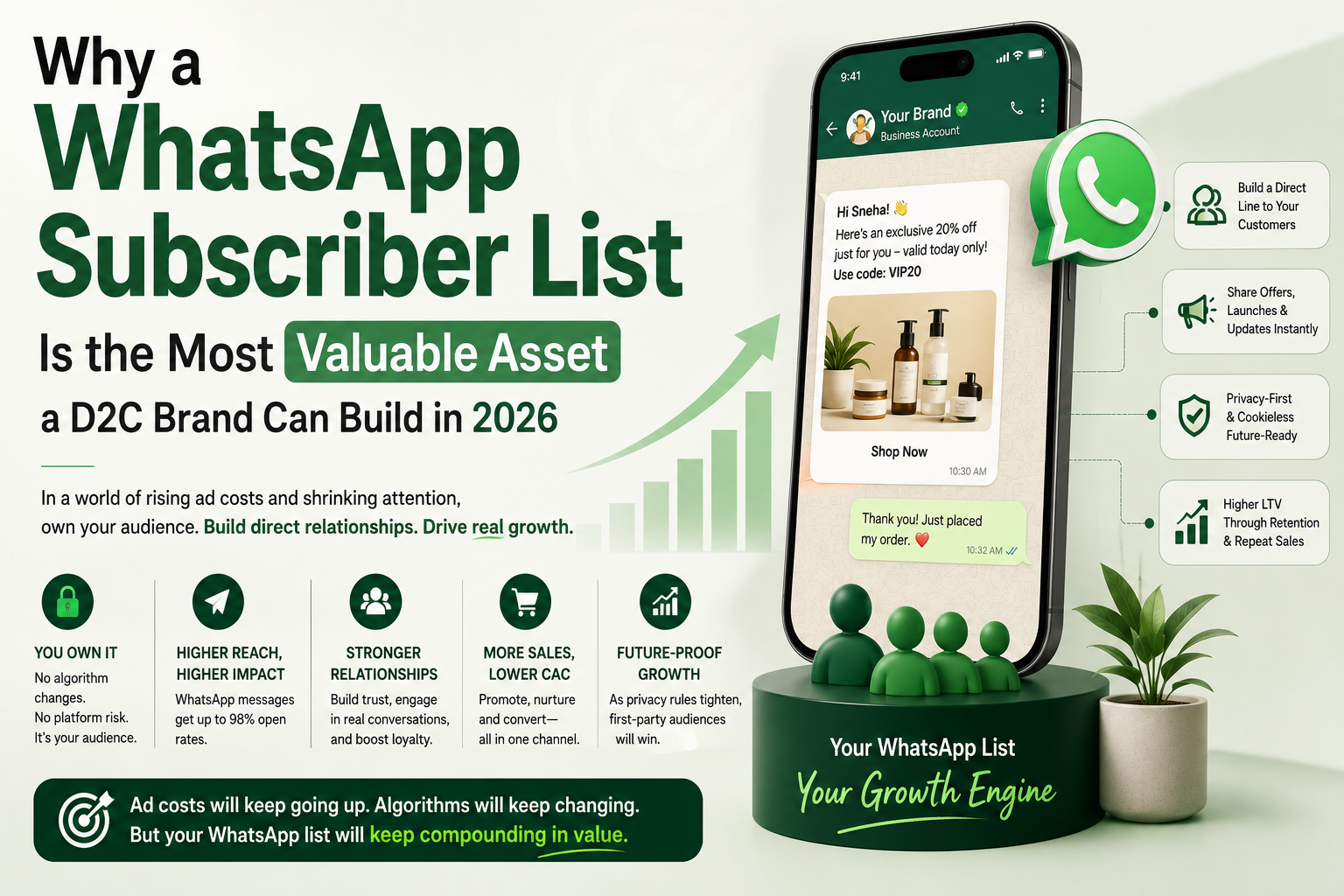
Why a WhatsApp Subscriber List Is the Most Valuable Asset a D2C Brand Can Build in 2026
Here is a question most D2C founders have never seriously considered.
If Instagram shut down your account tomorrow morning, how many of your customers could you still reach?
For a brand with 200,000 Instagram followers and no owned communication channel, the honest answer is close to zero. Years of content, ad spend, and audience building, gone overnight because of a policy violation, an algorithm update, or a platform decision that had nothing to do with your brand.
This is not a hypothetical risk. It is the structural reality of building a growth model on rented platforms.
In 2026, the most valuable marketing asset a D2C brand can build is not a social media following. It is a WhatsApp subscriber list. This piece explains exactly why, what the economics look like, and how the brands that understand this are building a competitive advantage that becomes harder to close every year they compound it.
The Rented Attention Problem
Social media reach is not what it used to be.
Average organic reach for an Instagram business account post currently sits between 3 and 5 percent of total followers. That means a brand with 100,000 followers is reaching 3,000 to 5,000 people with an organic post. The other 95,000 followers the brand paid to acquire see nothing unless the brand pays again to boost the content.
Facebook organic reach for business pages is even lower, averaging between 1 and 3 percent in most categories.
This is not a temporary platform quirk. It is the deliberate architecture of advertising-supported social media. The platform's business model depends on brands paying for reach. Organic reach will not improve. If anything, it will continue to decline as more brands compete for the same feed space.
Every follower a D2C brand has on Instagram exists on infrastructure the brand does not own. The platform decides who sees what, when, and at what cost. The brand is a tenant paying rent for access to an audience it technically built but does not control.
A WhatsApp subscriber list operates on entirely different terms.
What Owned Actually Means
When a customer gives a brand their WhatsApp number and opts in to receive messages, they are granting direct access that no platform can revoke, throttle, or monetise against the brand.
A message sent to a WhatsApp subscriber list does not go through an algorithm. It does not compete with 50 other posts for attention in a feed. It arrives in the same notification space as messages from the subscriber's family, closest friends, and most trusted contacts.
Average WhatsApp message open rates sit between 94 and 98 percent.
To put that in context: for every 100 customers a brand reaches on Instagram through an organic post, it reaches 4. For every 100 customers on its WhatsApp subscriber list, it reaches 96.
This is not a marginal difference. It is a structural one. And it compounds with every subscriber added to the list.
The Indian Market Context Makes This Even More Significant
India has over 500 million active WhatsApp users, making it the single largest WhatsApp market in the world.
For Indian consumers, WhatsApp is not one of many communication apps. It is the primary layer through which personal relationships, business transactions, customer service interactions, and purchasing decisions all happen. Bank alerts arrive on WhatsApp. Delivery updates arrive on WhatsApp. Family conversations happen on WhatsApp.
A brand that earns a place on that channel has earned a level of proximity to the customer that no social media platform can replicate.
The Indian D2C buyer who follows a brand on Instagram encounters it occasionally, between posts from friends, influencers, and other brands, when the algorithm decides to show them something.
The Indian D2C buyer who is on a brand's WhatsApp list hears from that brand directly, immediately, and with near certainty that the message will be read.
The Economics of Ownership Versus Renting
The financial case for building a WhatsApp subscriber list becomes most visible during high-cost advertising periods.
During the Diwali 2023 festive season, Meta CPMs for Indian D2C brands increased by 60 to 80 percent compared to non-festive periods. Brands that were entirely dependent on paid social to reach their customers had no alternative but to absorb that cost increase. Their customer acquisition and reactivation budgets doubled in the weeks when they needed to be most efficient.
Brands with an owned WhatsApp subscriber list sent their entire Diwali campaign for a fraction of a rupee per message. A 20,000 person WhatsApp list reached at Rs 0.80 per message costs Rs 16,000 to activate. The equivalent reach through boosted Instagram posts during peak festive CPMs would cost significantly more and reach the audience with far less certainty.
Owned communication lists do not get more expensive during Diwali. They do not respond to platform auction dynamics. They simply work, at the same cost, every time.
Building the List: Where the Subscribers Come From
One of the most common misconceptions about building a WhatsApp subscriber list is that it requires a separate acquisition effort, a new campaign, a new budget, a new strategy.
It does not. The inputs already exist in most D2C businesses.
Every customer who has completed a purchase has given the brand their phone number. Every abandoned cart represents a visitor with enough intent to add a product but not enough friction cleared to complete the purchase. Every lead form submission, every contest entry, every giveaway participant is a warm contact waiting to be onboarded into a direct communication channel.
The opportunity is not to find new people. It is to convert the people already interacting with the brand into WhatsApp subscribers before they become cold.
Opt-in rates at the three highest-intent moments, post-purchase confirmation, abandoned cart recovery, and lead magnet delivery, consistently run between 35 and 55 percent across the brands we work with at Waapper. A brand processing 500 orders per month and converting 40 percent of those buyers into WhatsApp subscribers is adding 200 owned contacts every single month without spending an additional rupee on acquisition.
After 12 months, that brand has an owned list of 2,400 highly engaged, already-converted customers it can reach directly, immediately, and at near-zero cost.
What the List Produces Once It Is Built
A WhatsApp subscriber list is not a static asset. It is a revenue engine.
The simplest illustration: a D2C brand with a 15,000 person WhatsApp subscriber list sends a single Diwali broadcast with a 48-hour exclusive offer. At a 94 percent open rate, 14,100 people read the message. At a 10 percent conversion rate on the offer, the brand generates 1,410 orders from one message. At Rs 2,000 average order value, that single broadcast produces Rs 28.2 lakh in revenue.
No new ad spend. No new audience to find. No algorithm to negotiate with.
Just a message, sent directly to people who already trust the brand, on the channel they already open 94 times out of 100.
This is what Waapper helps D2C brands build systematically. The opt-in infrastructure to grow the list at every high-intent touchpoint. The automation to nurture subscribers through personalised post-purchase sequences. The broadcast capability to activate the entire list during high-value moments. And the analytics to understand which messages are converting and which subscribers need a different approach.
The Compounding Advantage
Here is the final reason building a WhatsApp subscriber list matters more than growing a social following in 2026.
Social followings do not compound in a way that benefits the brand. More followers means slightly more organic reach on a platform that is actively reducing organic reach. The asset inflates in size while the actual access it provides barely moves.
A WhatsApp subscriber list compounds directly. More subscribers means more people reached per broadcast. More people reached means more orders generated per send. More orders means more data on what converts. Better conversion data means better messages. Better messages means higher retention and more word-of-mouth referrals who become subscribers themselves.
The brands building this asset today will have a list in two years that their competitors cannot replicate quickly, regardless of how much they spend.
Social media built the awareness. The WhatsApp list converts it into something that actually belongs to the brand.
Start building yours. Visit waapper.com.