What Quick Commerce Taught Indian Consumers That Every D2C Brand Now Has to Reckon With
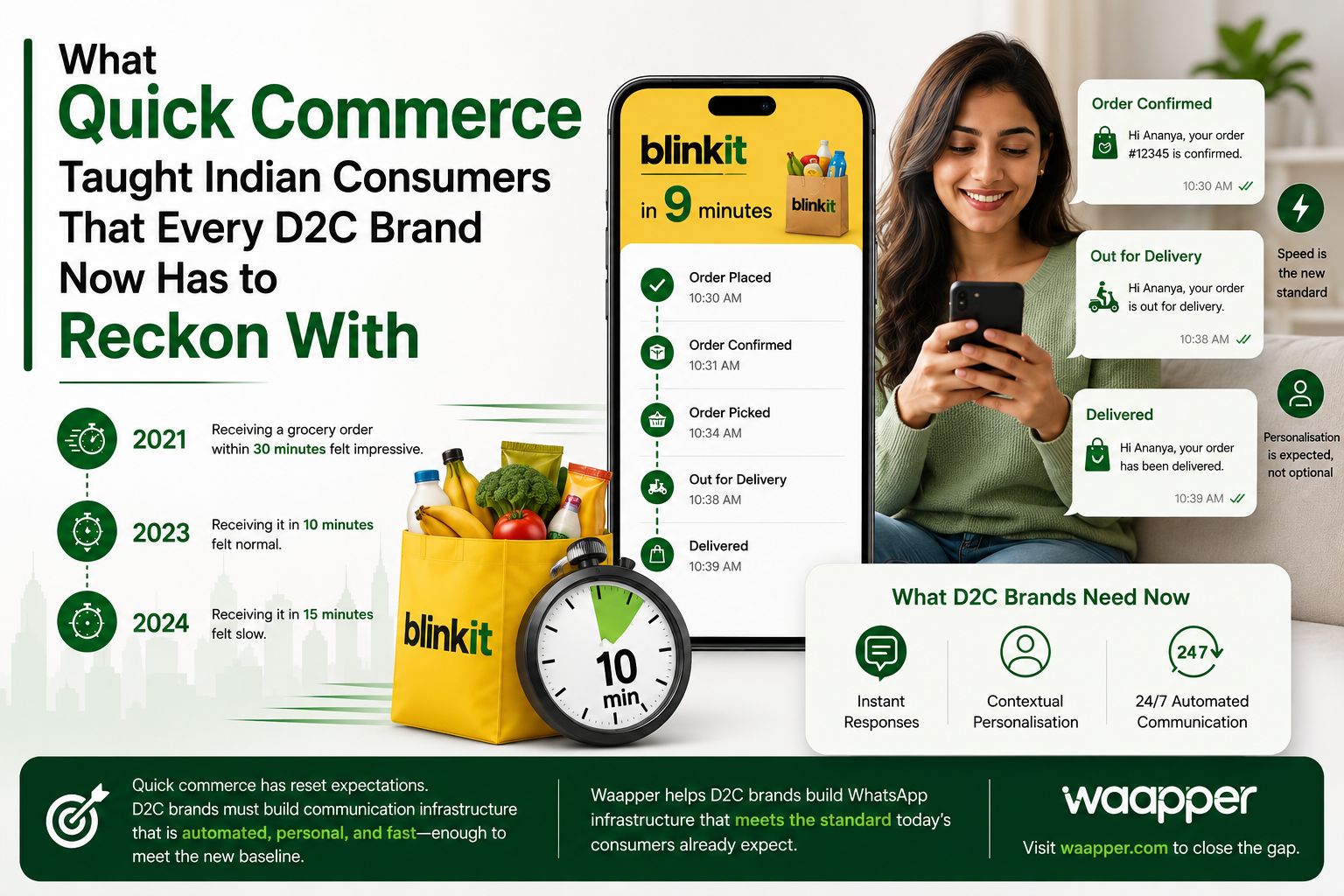
In 2021, receiving a grocery order within 30 minutes felt impressive.
By 2023, receiving it in 10 minutes felt normal.
By 2024, receiving it in 15 minutes felt slow.
This is the nature of expectation compression. Once a new standard is set in any category, the standard does not stay in that category. It bleeds into every adjacent experience. It becomes the reference point against which consumers evaluate brands they have never consciously compared to quick commerce.
Blinkit, Zepto, and Swiggy Instamart did not just build fast grocery delivery businesses. They permanently rewired what tens of millions of Indian consumers now consider acceptable communication and service speed from every brand they interact with.
This piece breaks down exactly what shifted, why the expectation does not stay contained to the category where it was created, what the data shows about how dramatically Indian consumer standards have moved, and what D2C brands need to build into their communication infrastructure to meet the new baseline.
How Expectation Compression Works
Consumer expectations do not operate in the neat category boundaries that brands use to think about their competitive landscape.
A customer who experiences 10-minute delivery, real-time tracking updates, and immediate customer service resolution through a quick commerce app does not file that experience under grocery delivery and leave it there. They integrate it into their general model of what good service looks like.
The next time that customer interacts with a D2C brand in any category, their evaluation of that brand's service is influenced by the best experience they have had with any brand recently. This is a well-documented psychological phenomenon called expectation anchoring. The reference point for good moves up whenever any brand delivers something significantly better than the previous standard.
Blinkit delivering in 9 minutes became an anchor. Every subsequent brand interaction is measured, unconsciously, against that anchor.
The D2C skincare brand whose customer support replies within four hours is not being compared to other skincare brands' support response times. It is being compared to the 9-minute standard that the customer now carries as their internal benchmark for how fast a brand can and therefore should respond.
The Two Things Quick Commerce Specifically Normalised
The quick commerce shift in Indian consumer expectations was not just about delivery speed. It normalised two specific things that have implications for every aspect of D2C brand communication.
The first is immediacy. Quick commerce trained Indian consumers to expect real-time updates, immediate acknowledgement, and rapid resolution as defaults rather than premium features. Order placed: immediate confirmation. Order picked: immediate notification. Delay encountered: immediate communication with an explanation and revised timeline. The entire experience is a continuous stream of timely, relevant updates that keep the customer informed without them having to seek information.
Before quick commerce normalised this cadence, a D2C brand that sent a shipping confirmation email within two hours of dispatch was considered responsive. Today, a customer who places an order and does not receive immediate WhatsApp confirmation feels a low-level anxiety that did not exist before the quick commerce baseline was established.
The second is effortless personalisation. Quick commerce apps remember previous orders, surface frequently purchased items automatically, and anticipate reorder needs based on consumption patterns without requiring the customer to set up preferences explicitly. The experience of being remembered without effort became the expectation.
A D2C brand that asks a repeat customer to re-enter their address, spell out their order number, or explain their previous purchase history before receiving assistance has created friction that would have been entirely unremarkable in 2019. Against the current expectation baseline, it feels like a failure.
What the Data Shows About Shifted Expectations
The expectation shift is not anecdotal. It is measurable in consumer research across the Indian market.
A 2023 survey of Indian e-commerce consumers found that 67 percent considered a response time of under one hour to be the minimum acceptable standard for customer service communication. The same survey in 2019 found that 24-hour response time was acceptable to the majority of respondents.
The acceptable response time standard moved by a factor of 24 in four years. Not because consumers became more demanding in some abstract sense. Because quick commerce showed them that faster was possible and their expectations adjusted accordingly.
The implications for D2C brands are direct. A brand whose WhatsApp customer service currently operates on a morning-check-in basis, responding to messages from the previous evening when the team logs in at 9 AM, is not delivering a slightly suboptimal experience. It is delivering an experience that 67 percent of its customers now classify as below acceptable minimum standards.
The gap between where customer expectations sit and where most D2C brand communication infrastructure sits is not narrowing on its own. It requires an active decision to close it.
Why WhatsApp Is the Specific Channel Where This Gap Is Most Visible
Quick commerce normalised expectations on WhatsApp specifically.
Blinkit sends order confirmations on WhatsApp. Zepto sends delivery updates on WhatsApp. Swiggy sends tracking links on WhatsApp. The communication cadence that created the new expectation baseline was delivered primarily through WhatsApp because that is where Indian consumers have already decided they want real-time brand communication to happen.
This means the expectation compression effect is strongest on WhatsApp. A D2C brand that communicates with customers on WhatsApp is operating in the same channel where the quick commerce standard was established and is therefore most directly subject to the comparison.
A D2C brand that responds to a customer WhatsApp message the following morning is not failing to meet a vague general expectation of promptness. It is failing to meet the specific standard that the customer's daily quick commerce interactions have established on that specific channel.
The brands that are meeting this standard are not doing it by hiring overnight WhatsApp response teams. They are doing it through automation that delivers the speed and personalisation that customers now expect without requiring human availability around the clock.
What Meeting the New Baseline Actually Requires
The quick commerce experience that customers now reference as their benchmark has two components: speed and contextual personalisation. Meeting both at scale requires infrastructure rather than headcount.
Speed at scale means automated responses that acknowledge customer messages immediately, provide accurate information without requiring a human to locate it, and initiate the resolution process before a human agent picks up the conversation. A customer who messages at 11 PM asking about their order status should receive an immediate, accurate response. The brand does not need someone working at 11 PM to deliver that. It needs automation configured to deliver it.
Personalisation at scale means the automated response knows who the customer is, what they ordered, and what their most likely question is based on where they are in the post-purchase journey. When a Waapper-powered WhatsApp response addresses a customer by name, references their specific order, and provides the exact information relevant to their current stage without them having to provide any context, it replicates the effortless personalisation that quick commerce normalised.
The customer does not know the response is automated. They know it felt immediate and personal. That is the experience that meets the new baseline.
At Waapper, we build WhatsApp communication infrastructure for D2C brands that delivers both components of the quick commerce expectation. Automated responses that arrive within seconds of a customer message. Personalised content that reflects the customer's specific purchase history, current order status, and likely next need. Communication flows that run across every hour of the day without requiring a human to be available to trigger them.
The brands we work with that have implemented this infrastructure report significant improvements in customer satisfaction scores, meaningful reductions in complaint volumes, and repeat purchase rates that move above category averages as customers experience the brand as reliably responsive and genuinely attentive.
The Baseline Has Moved. The Response Is Infrastructure.
Quick commerce did not create unreasonable customers. It created informed customers who now know what fast and personal actually looks like because they experience it multiple times a week.
The D2C brands that treat this expectation shift as someone else's problem are accumulating a trust deficit with every interaction that falls below the new baseline. The brands that treat it as an infrastructure problem to solve are closing the gap and building the communication standard that converts first-time buyers into habitual customers.
Speed and personalisation are no longer premium features. They are table stakes. The brands that have already built the infrastructure to deliver them on WhatsApp are not exceeding customer expectations. They are meeting them.
Waapper helps D2C brands build that infrastructure. Automated, personal, and fast enough to meet the standard that Blinkit permanently installed in every Indian consumer who has ever received a delivery in under 10 minutes.
Visit waapper.com to close the gap.