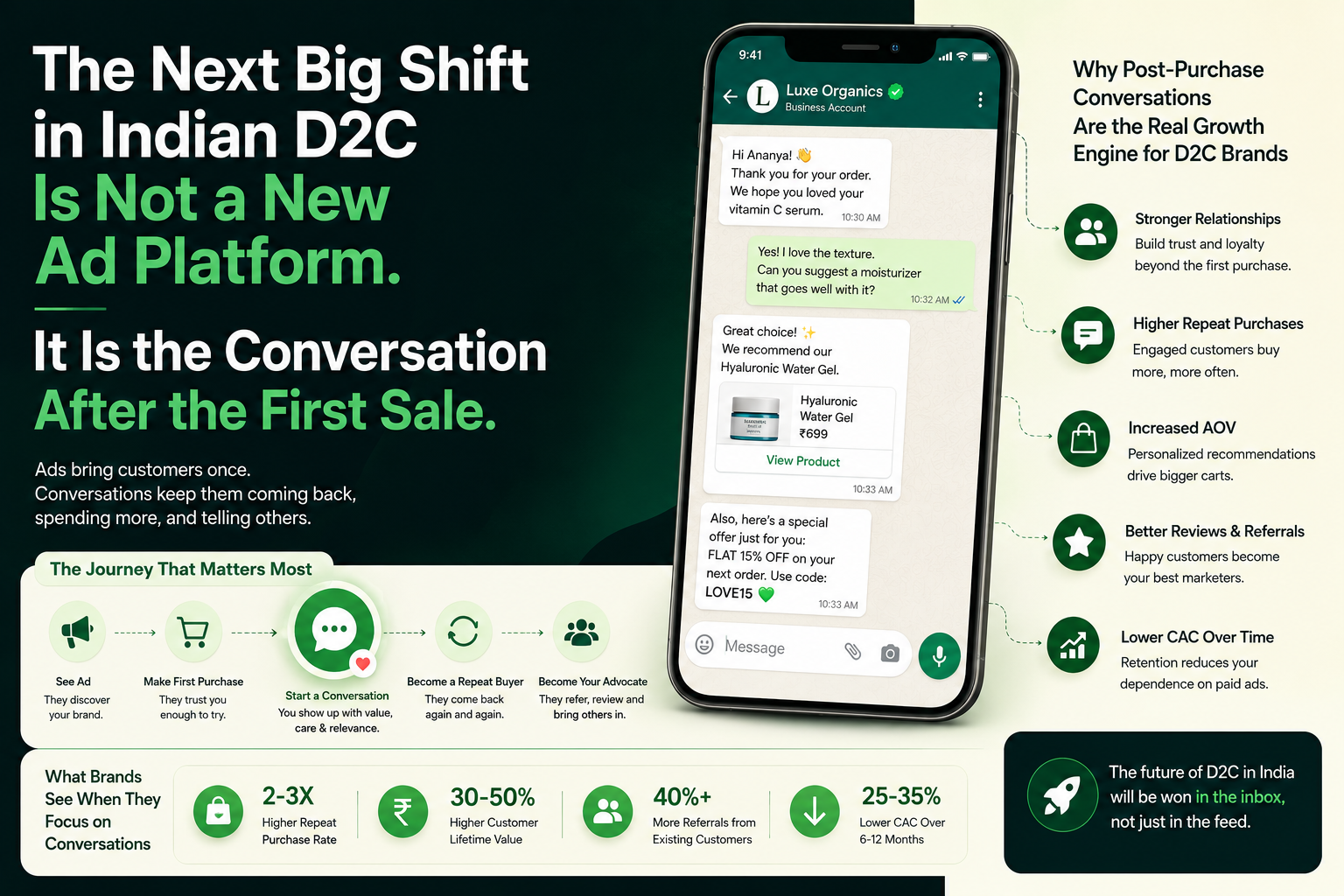
The Next Big Shift in Indian D2C Is Not a New Ad Platform. It Is the Conversation After the First Sale.
Every meaningful shift in Indian D2C over the last decade followed the same pattern.
A new channel or behaviour emerged. The founders who recognised it early moved fast and built advantages that compounded over time. By the time the broader market caught up, the channel was crowded, the costs had risen, and the window for outsized early-mover returns had closed.
Facebook advertising in 2015 gave D2C brands access to targeted customer acquisition at a cost that made the economics of direct-to-consumer viable for the first time without heavy retail distribution investment. The brands that figured out Facebook's targeting capabilities in 2015 and 2016 were paying Rs 2 to Rs 5 per click for customers their competitors would spend Rs 60 to Rs 80 to reach just four years later.
Instagram's rise as a visual discovery platform between 2017 and 2019 created another early-mover window. Brands that understood how to build audiences through organic content and influencer partnerships before those costs inflated built customer bases that their late-moving competitors effectively could not afford to replicate at the same economics.
The pattern is consistent. The window is always real. And the window is always finite.
We believe at Waapper that the next window is open right now. And unlike every previous shift, this one has nothing to do with a new platform, a new ad format, or a new discovery channel.
It has everything to do with what happens after the first sale.
Why Acquisition Has Become a Treadmill
The Indian D2C market in 2026 is more competitive at the acquisition level than it has ever been.
Meta CPMs for D2C categories increased significantly between 2022 and 2024. Google search costs for high-intent keywords in competitive categories like beauty, nutrition, and apparel have followed a similar trajectory. The influencer marketing cost curve has moved steeply upward as creator fees have risen alongside follower counts.
Every D2C brand is competing for the same customer on the same channels at increasingly expensive entry prices. The brands with the largest budgets have structural advantages in this environment. Smaller and mid-sized D2C founders are fighting a cost-per-acquisition battle against opponents who can simply outspend them.
This is not a solvable problem at the acquisition level. More creative testing, better targeting, and smarter bidding strategies help at the margins. They do not change the fundamental dynamic that acquisition costs in Indian D2C will continue rising and the sustainable competitive advantage available to brands that cannot simply outspend their competitors lies somewhere else entirely.
That somewhere else is the post-sale conversation.
What the Post-Sale Conversation Actually Means
The phrase post-sale conversation refers to everything a brand communicates with a customer after the first purchase has been completed.
Most D2C brands treat this period as silence punctuated by occasional promotional emails. The customer has bought. The transaction is complete. The brand's attention moves to finding the next customer.
The problem with this approach is not just that it misses retention opportunities. It is that it actively cedes the customer relationship to whoever does show up in the post-purchase period.
In the 30 to 60 days after a first purchase, a D2C customer's behaviour follows a predictable pattern. They use the product and form an opinion on whether it delivered on the brand's promise. They return to their normal consumption patterns, which include seeing competitor ads, visiting other stores, and encountering alternatives they had not previously considered. And they approach their natural reorder window, at which point the decision of where to buy is made largely based on which brand is most present in their awareness at that moment.
A brand that communicates relevantly and personally during this period shapes all three of those moments. It receives the feedback that confirms the product is delivering. It stays present in the customer's awareness during the period of competitor exposure. And it reaches the customer at the reorder moment before a competitor's ad does.
A brand that is silent during this period shapes none of them.
The Channel That Makes This Possible at Scale
The strategic importance of the post-sale conversation has been understood by sophisticated D2C operators for years. The reason most brands have not built infrastructure around it is not a lack of understanding. It is a channel problem.
Email post-purchase sequences reach 18 to 22 percent of the customers they are sent to. For a brand sending a reorder nudge 35 days after purchase, the realistic open rate is lower because the customer's relationship with promotional email has deteriorated and the message is competing with a full inbox for attention.
Building post-sale conversation infrastructure on a channel where 78 percent of the communication is invisible produces 78 percent less impact than the strategy would generate on a channel with full reach.
WhatsApp changes this calculation fundamentally.
India has over 500 million active WhatsApp users. Open rates for WhatsApp messages in the Indian market consistently run between 94 and 98 percent. A post-purchase check-in sent via WhatsApp on day 3 after delivery is read by 95 out of every 100 customers who receive it. A reorder nudge sent on day 30 reaches the same percentage.
The post-sale conversation strategy is the same regardless of channel. WhatsApp is the channel where it actually works.
The Early-Mover Advantage and Why It Compounds
Here is what makes the current moment comparable to the early Facebook ads window in 2015.
The WhatsApp API has existed for several years. The capability to run personalised, automated post-purchase communication at scale through WhatsApp is not new. What is new is the combination of increasing awareness among D2C founders that this capability exists, improving platform tools that make implementation accessible without technical resources, and a growing body of performance data demonstrating what the strategy produces.
This combination means the window is open but not yet crowded.
The brands building WhatsApp post-sale conversation infrastructure in 2025 and 2026 are building a customer communication asset that compounds with every subscriber added. A WhatsApp subscriber list of 50,000 customers who have opted in to brand communication is not just a list. It is a revenue engine that generates returns every time it is activated, at a cost per message that is a fraction of a rupee.
That list takes time to build. The brands building it now will have an asset in two years that their late-moving competitors cannot replicate quickly regardless of how much they spend on the effort.
At Waapper, we track the performance outcomes of brands implementing post-sale WhatsApp conversation infrastructure consistently. The Day 90 Retention Rates we see among brands running structured WhatsApp post-purchase sequences sit between 28 and 35 percent. The Indian D2C category average sits between 12 and 18 percent.
That gap between 15 percent and 32 percent is not a marginal difference. For a brand processing 1,000 orders per month, the difference between a 15 percent and a 32 percent Day 90 Retention Rate is 170 additional orders per month from customers who cost nothing to reacquire. At an average order value of Rs 2,000, that is Rs 3.4 lakh per month in incremental revenue generated entirely from the post-sale conversation.
What the Shift Looks Like From the Inside
The brands that will look back at 2026 the way early Facebook ads founders look back at 2015 are not the ones waiting for the post-sale conversation shift to become obvious before they invest in it.
They are the ones building the infrastructure now, before the channel becomes crowded, before the best practices are commoditised, and before the early-mover compounding advantage has been fully claimed.
The post-sale conversation shift does not require a new platform to exist. It does not depend on an algorithm change or a regulatory decision. It is available to every D2C brand with a WhatsApp API connection and the willingness to build communication infrastructure around the customer relationship that already exists after the first sale.
Waapper is that infrastructure. Automated WhatsApp flows that turn first-time buyers into repeat customers. Abandoned cart recovery that catches purchase intent before it decays. Post-purchase sequences that build the trust that makes a customer's second and third purchases feel like the obvious choice rather than a considered decision.
Conclusion
The next shift in Indian D2C is the conversation after the first sale.
The brands starting that conversation today are already building the advantage.
Visit waapper.com to start building yours.