How Sugar Cosmetics Built 500 Crore in Revenue Without Being the Cheapest Brand in the Room
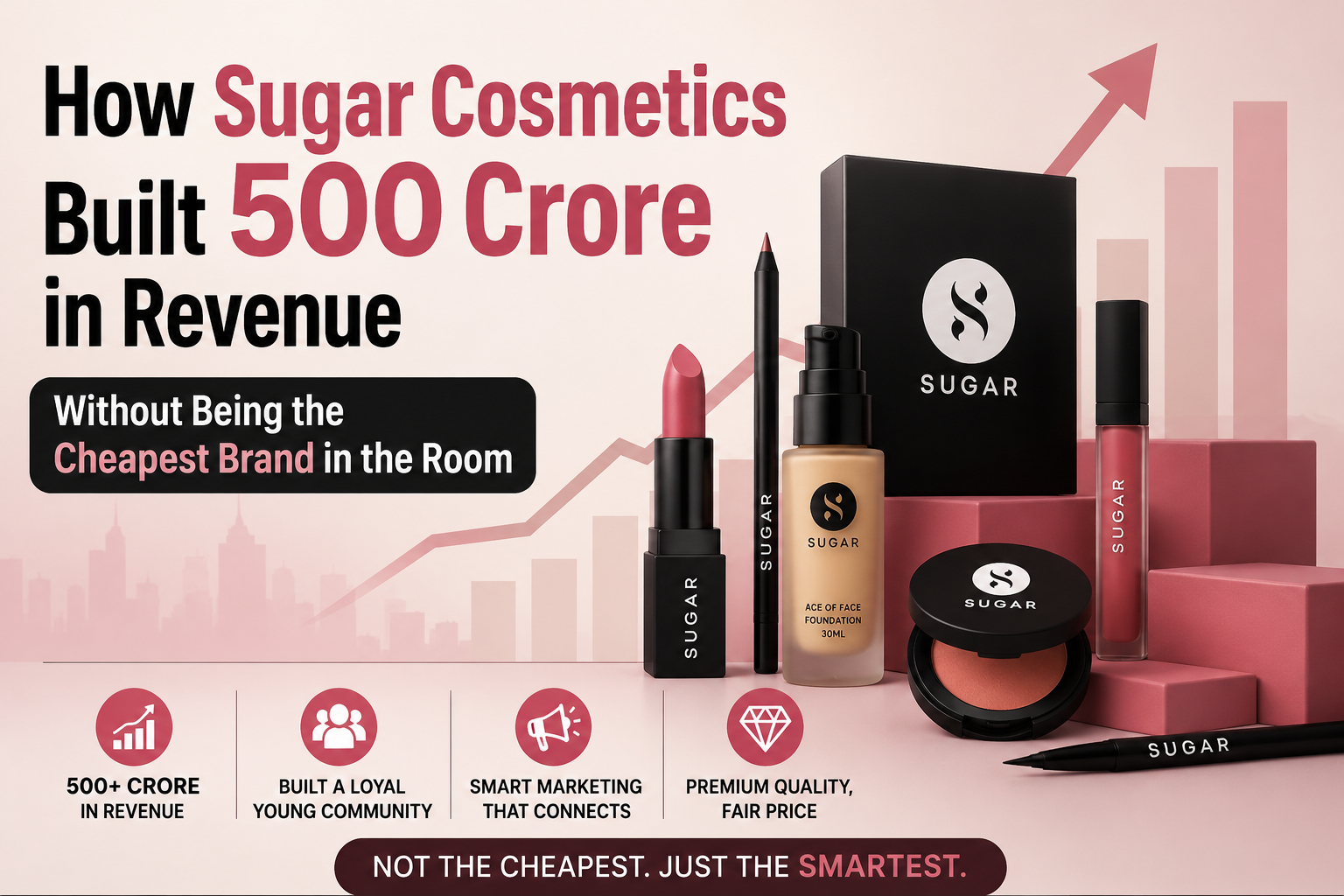
Sugar Cosmetics launched in 2015 into one of the most competitive retail categories in India.
They were not the cheapest. They were not the most widely distributed. They did not have the legacy of Lakme or the international credibility of Maybelline. They had a focused product line, a clear point of view on who they were building for, and a trust-building playbook that most of their competitors did not recognise as a competitive advantage until it was too late to replicate.
By the time Sugar crossed 500 crore in revenue, they had proved something that changes how every D2C founder should think about growth: in Indian consumer markets, the most trusted brand wins more reliably than the cheapest brand, the most advertised brand, or the most widely available brand.
This piece breaks down the strategic logic behind Sugar's rise, what their trust architecture actually consisted of, and how D2C brands in 2026 can build a version of the same system using WhatsApp as the primary communication layer.
The Market Gap That Made Trust the Strategy
To understand why Sugar's approach worked, it is important to understand the gap they were filling.
The Indian beauty market in 2015 was dominated by two types of players. Legacy domestic brands that had wide distribution and strong retailer relationships but products largely designed for an older consumer base with limited shade diversity. And international brands that carried premium positioning but spoke to an Indian audience through global campaigns that felt distant and irrelevant.
The young Indian woman buying cosmetics in 2015 was caught between products that did not match her skin tone and brands that did not speak her language.
Sugar's founding insight was that relevance was a more powerful differentiator than price. If a brand could make a customer feel genuinely understood, that customer would pay more, return more often, and advocate more loudly than a customer who bought primarily because a product was affordable.
They were right. And the 500 crore revenue number is the proof.
What Trust Architecture Actually Means
Trust in a consumer brand is not built through a single interaction. It is built through repeated, relevant contact that confirms for the customer, over and over, that the brand understands them and delivers on its promises.
Sugar built their trust architecture across three distinct dimensions.
The first was product truth. Their formulations, particularly their matte lipsticks and long-wear foundations, delivered exactly what the brand promised for the Indian climate and skin type. A customer who bought a Sugar product and found that it lasted through a humid Mumbai afternoon told three other people. Product truth creates word of mouth that advertising cannot replicate.
The second was communication relevance. Sugar talked to their customer like a peer, not like a brand. Their social media was educational, specific, and conversational. They taught their audience how to use the products, how to build looks, how to choose shades for different undertones. They generated trust through value delivery before the sale rather than promotional messaging after it.
The third was community presence. Sugar built a community of beauty enthusiasts who felt ownership over the brand's direction. They took feedback publicly. They launched products that came directly from customer requests. They made their buyers feel like collaborators rather than consumers.
Together, these three dimensions created a customer relationship that was extraordinarily difficult for competitors to disrupt with a lower-priced alternative or a flashier campaign.
The Economics of Trust Versus the Economics of Acquisition
The financial case for trust-based growth becomes clear when the numbers are examined honestly.
A first-time buyer who purchased primarily because of a discount or a competitive price has no particular loyalty to the brand that sold them. When the discount disappears or a competitor offers a better deal, they leave. The acquisition cost was real. The retention was not.
A first-time buyer who purchased because they trusted the brand's recommendation, felt understood by the brand's communication, and had a product experience that matched the promise the brand made has a completely different behavioural profile.
Research on brand trust in consumer categories shows that trusted brands enjoy conversion rates 3 to 5 times higher among returning visitors than untrusted brands. Their return rates on purchases are 60 percent lower. And their net promoter scores are high enough to generate meaningful organic referral traffic that reduces the effective cost of new customer acquisition over time.
Trust does not show up in a ROAS dashboard. But it shows up in lifetime value, in referral behaviour, and in the resilience of a brand's revenue during periods when advertising costs spike.
Sugar's ability to sustain premium pricing while growing to 500 crore is the clearest possible demonstration of what a trusted brand can sustain that an untrusted brand cannot.
The Channel Problem That Makes 2026 Different From 2016
Sugar built their trust architecture primarily through social media content, community engagement, and in-store experience.
That approach worked in 2016 and 2017 for a specific reason: organic social media reach was high enough that consistent, quality content could reach a meaningful percentage of a brand's following without paid amplification.
In 2026, that condition no longer exists.
Average organic reach for an Instagram business account currently sits between 3 and 5 percent of total followers. A brand with 200,000 Instagram followers that posts educational beauty content four times a week is reaching 6,000 to 10,000 people per post. The other 190,000 followers see nothing unless the brand pays to reach them.
Trust architecture cannot be built through communication that 95 percent of the intended audience never sees.
The brands replicating Sugar's trust-building approach in 2026 are doing it on a channel where the communication actually lands. And in the Indian market, that channel is WhatsApp.
How WhatsApp Replicates the Sugar Trust Playbook at Scale
WhatsApp message open rates in India sit between 94 and 98 percent. A brand with 20,000 WhatsApp subscribers that sends a personalised post-purchase educational message reaches 18,800 to 19,600 of those subscribers with near certainty.
The same message sent via email reaches 3,600 to 4,400 of them.
Trust is built through repeated, relevant contact. If the contact is invisible, the trust does not accumulate. WhatsApp removes the visibility problem entirely.
The trust-building sequence that D2C beauty brands are building on WhatsApp mirrors Sugar's approach in three specific ways.
Education Before Promotion
The most effective WhatsApp sequences for beauty brands do not lead with offers. They lead with value. How to use the product they just bought. What complementary products work well with their recent purchase. Shade matching advice based on their purchase history. These messages build the perception of expertise and genuine care that creates the same trust response Sugar built through community content.
Personalisation at Scale
Sugar's community approach worked because customers felt individually seen by the brand. WhatsApp automation allows a brand to reference a specific customer's purchase history, use their name, acknowledge their loyalty tier, and tailor recommendations to their demonstrated preferences. At 50,000 subscribers, this level of personalisation is impossible manually. Automated, it is the default.
Consistency Without Platform Dependency
Sugar's community building was vulnerable to algorithm changes on social platforms. A WhatsApp subscriber list is an owned asset. The brand controls the reach. No algorithm decides how many subscribers receive the trust-building message on any given day.
At Waapper, we help D2C brands build this exact communication infrastructure. The brands implementing personalised, educational WhatsApp post-purchase sequences consistently see their repeat purchase rates move 15 to 20 percentage points above their pre-automation baseline within 60 to 90 days.
The Playbook Is Transferable
Sugar Cosmetics proved that the most trusted brand in a category wins more reliably than the cheapest.
They also proved that trust is not built through advertising. It is built through consistent, relevant, personal communication that makes a customer feel understood rather than targeted.
The playbook they used to build that trust is transferable to any D2C brand in any category. The difference between 2016 and 2026 is the channel.
Social media organic reach has declined to the point where trust architecture built entirely on social content is structurally limited. The brands replicating Sugar's advantage today are doing it on WhatsApp, where 97 percent of every trust-building message actually gets read.
Waapper helps D2C brands build WhatsApp communication sequences that compound trust with every interaction. Automated, personalised, and running without manual effort from your team.
The most valuable thing Sugar built was not their product range. It was the relationship they had with their customer.
That relationship is buildable on WhatsApp. At scale. Starting today.
Visit waapper.com to get started.