How Bombay Shaving Company Built Subscription-Level Retention Without Running a Subscription Business
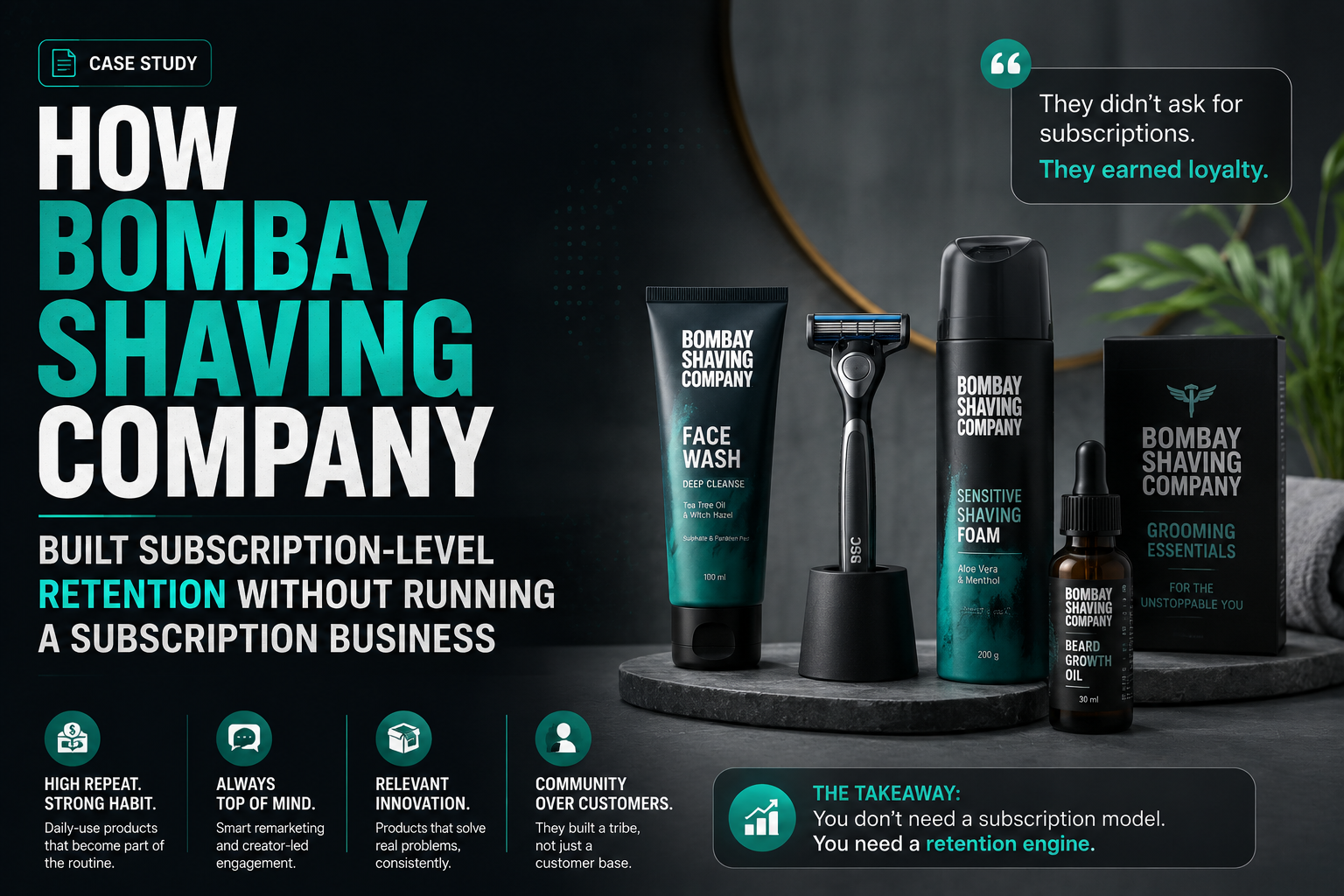
Bombay Shaving Company sells razors, foam, and post-shave balm.
None of those products come with a subscription attached. No monthly box. No locked-in commitment. No cancel-anytime banner. A customer can buy once and never return, and the brand has no contractual mechanism to stop them.
And yet, Bombay Shaving Company's repeat purchase rate sits among the highest in Indian D2C. Their customers come back not because they have to but because the brand has made coming back feel like the natural thing to do.
This piece breaks down the strategic logic behind how they achieved that, what the subscription mindset actually means when applied to a non-subscription product, and how D2C brands across categories can build the same retention engine without changing their product, pricing, or business model.
The Distinction That Changes Everything
Most D2C brands sell products.
Bombay Shaving Company sells a ritual.
Shaving is not a one-time purchase decision for the customer who buys their first kit. It is a daily act that repeats for the rest of their life. The brand that earns a place in that ritual does not need to convince the customer to come back. The ritual creates the demand automatically. The only question is which brand shows up when that demand surfaces.
This framing shifts the entire post-purchase strategy.
If you are selling a product, your job ends at delivery. If you are selling a ritual, delivery is the beginning of the relationship.
Bombay Shaving Company operates on the second model. And the repeat purchase behaviour of their customer base reflects that operational difference at scale.
Understanding the Consumption Cycle
The foundation of the subscription mindset applied to non-subscription products is consumption cycle mapping.
Every product has a natural usage duration. A razor blade lasts 30 to 45 days for an average user. A 100ml shaving foam runs out in 45 to 60 days. A post-shave balm lasts 60 to 90 days depending on usage frequency.
These timelines are not guesses. They are observable patterns. And a brand that maps those patterns can predict, with reasonable accuracy, when a customer is approaching the moment of reorder intent.
The critical insight is that reorder intent does not wait for the customer to run out. It surfaces 5 to 10 days before the product is finished, in the form of a low-level awareness that a repurchase will soon be needed.
If a brand reaches the customer at that moment with a relevant, personalised prompt, the reorder decision is frictionless. The customer was already planning to buy. The brand just made it easier to buy from them rather than from a store shelf or a competitor's website.
If the brand does not reach the customer at that moment, the decision gets made by whoever does. And in the Indian market, that is increasingly a quick commerce app with next-hour delivery, a local pharmacy with zero friction, or a competitor's retargeting ad that happened to appear at exactly the right time.
Why the Post-Purchase Period Is the Most Competitive Moment in D2C
Most D2C founders think of competition as what happens before the first purchase. Which brand wins the Google search? Which ad earns the click? Which product page converts?
The reality is that the most competitive moment in a D2C customer's journey is the 30 to 60 day window after their first purchase.
This is when the customer is evaluating whether the product delivered on its promise. This is when habit formation either happens or does not. And this is when every competitor who lost the first sale is running retargeting campaigns to capture the reorder.
A brand that goes silent during this window is not in a neutral position. It is actively losing ground to brands that understand the post-purchase period and are present in it.
Bombay Shaving Company is present in it. Consistently. Personally. And on the right channel.
The Channel Question
The subscription mindset strategy only works if the communication actually reaches the customer.
This is where most brands implementing a version of this approach fall short. They build the post-purchase communication sequence, map the consumption cycles, write the messages, and then deliver them via email.
Email post-purchase open rates in Indian e-commerce average between 18 and 22 percent. For a reorder nudge sent 35 days after purchase, the realistic open rate is lower because the customer's inbox has moved on and the email has less relevance signal than a promotional email sent closer to a purchase decision.
That means roughly 78 to 82 percent of a brand's post-purchase communication is invisible to the customer it is designed to reach.
WhatsApp changes this calculation fundamentally. Open rates between 92 and 97 percent mean that a reorder nudge sent via WhatsApp at day 35 is read by nearly every customer who receives it. The message that was invisible in the inbox becomes the first thing they read the morning it arrives.
The strategy is the same. The channel determines whether it actually functions.
In the Indian market specifically, WhatsApp carries a level of attention and trust that no other digital communication channel can match. A message that arrives on WhatsApp is treated differently from a message that arrives in an email inbox. It is read in the same context as personal messages. It is responded to. It prompts action in a way that promotional emails rarely do anymore.
What the Sequence Actually Looks Like
For a grooming brand implementing the subscription mindset through WhatsApp post-purchase automation, the communication sequence looks something like this.
Three days after delivery, a short message checks in on the product experience. No pitch. No upsell. A genuine inquiry that opens a two-way conversation and builds the trust that makes every subsequent message more effective.
At day 30, a blade replacement prompt arrives. It references the specific kit the customer purchased, acknowledges that most users find their blades are ready for replacement around this time, and makes the reorder a single tap away.
At day 50, a foam reorder nudge goes out, paired with an offer on a bundle that includes the foam and a complementary product they have not yet tried.
At day 75, a message acknowledging their loyalty, offering early access to a new product, or providing a small benefit reinforces that the brand values the relationship beyond the transaction.
No subscription box. No locked-in commitment. Behaviour that is functionally indistinguishable from a subscription in terms of purchase frequency and customer retention.
The Compounding Mathematics of Getting This Right
The financial case for the subscription mindset approach is straightforward when the numbers are examined across a customer's lifetime.
A one-time buyer generates a single order's worth of margin, against a full customer acquisition cost.
A customer who purchases three times within 90 days of their first order has a lifetime value that research consistently places at 5 to 7 times higher than a one-time buyer. The third purchase is the inflection point. After three purchases, buying from the same brand becomes the default rather than the considered decision.
At Waapper, we have tracked the impact of WhatsApp post-purchase sequences across D2C brands implementing the consumption cycle approach. The pattern is consistent. Day 90 Retention Rates move from 13 to 16 percent before implementation to 28 to 35 percent within 60 days of activating the sequence.
The cost of running the sequence per customer sits below Rs 3 in total messages sent across the full 75-day cycle.
The cost of acquiring a replacement customer for every one lost to post-purchase silence sits between Rs 600 and Rs 900.
The economics are not subtle. The brands that retain through communication compound their profitability in a way that acquisition-only models cannot match.
The Insight That Applies Beyond Grooming
Bombay Shaving Company's approach works because shaving is a ritual with a predictable consumption cycle. But the underlying principle applies to every D2C category with repeat purchase potential.
Skincare products have usage cycles. Coffee and nutrition supplements have consumption timelines. Apparel has seasonal patterns. Pet food has monthly reorder windows.
Every brand that sells a product someone will eventually need again has the inputs to build a subscription mindset communication system. The question is not whether the strategy applies. The question is whether the brand has the infrastructure to execute it.
Waapper helps D2C brands build that infrastructure on WhatsApp. Automated consumption-cycle-aware post-purchase sequences that reach customers on the highest-engagement channel available, at exactly the moment their reorder intent is forming, without any manual effort from the brand's team.
You do not need to run a subscription business to have subscription-level retention.
You need to show up at the right moment on the right channel with the right message.
Visit waapper.com to build that system for your brand.