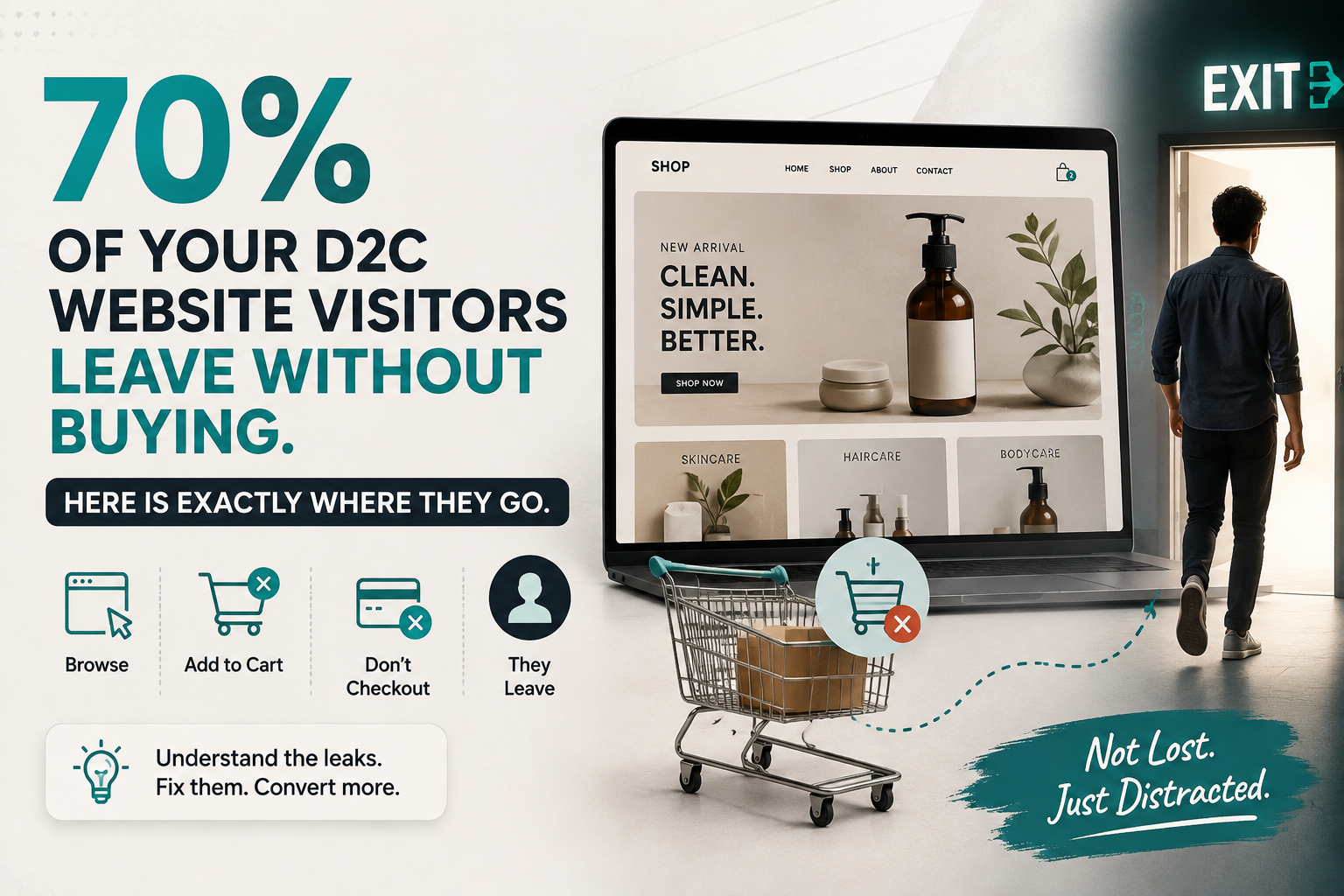
70 Percent of Your D2C Website Visitors Leave Without Buying. Here Is Exactly Where They Go.
You spent money getting them there.
They browsed your products, added something to their cart, and then disappeared. No purchase. No message. No warning.
If you are running a D2C brand in India, this is happening to roughly 70 percent of every person who visits your website. It is one of the most expensive and most ignored revenue problems in e-commerce, and most brands are solving it with the wrong tool.
This piece breaks down exactly where those visitors go, why they do not come back, and what the data says about the only recovery channel that actually works at scale.
The Abandonment Reality Most Brands Misread
Cart abandonment is not a traffic problem. It is a timing and channel problem.
The global cart abandonment rate sits at 70.19 percent according to the Baymard Institute, making it one of the most consistent and costly patterns in all of e-commerce. In India, where mobile-first shopping behaviour means customers are jumping between apps, taking calls, and responding to notifications all while browsing, that number can sit even higher for certain categories.
But here is what the data consistently shows that most founders miss: the abandoning visitor is not a lost visitor. They are a delayed one.
Research from Rejoiner shows that 72 percent of cart abandoners intend to return. They were not rejecting your product. They were undecided at that specific moment. And undecided buyers, if not caught within 20 to 30 minutes, will either land on a competitor's website, forget your brand name entirely, or move on to something that had nothing to do with shopping at all.
The window to recover them is small. What you do in that window determines whether that visitor becomes revenue or a wasted ad spend.
Where They Actually Go After Leaving
Understanding the post-abandonment behaviour of a D2C shopper gives you a clear picture of why most standard recovery efforts fail.
The competitor redirect is the most common scenario. A buyer who was comparing your protein powder to two others has all three tabs open simultaneously. When they leave your site without buying, the lowest-friction competitor often wins simply by being present when the buyer makes their final decision.
The distraction loop is equally common, particularly on mobile. A notification, a WhatsApp message, a phone call. The purchase intent does not disappear but the momentum breaks. And once momentum breaks, restarting it requires effort. Most buyers will not make that effort unless something pulls them back.
The memory gap is the quietest killer. For a brand without strong recall, a buyer who leaves and does not hear from you again within 30 minutes is unlikely to remember your domain when they decide to complete their purchase later. They will search generically and click the first result. Which may or may not be you.
Why Email Recovery Is Not Enough Anymore
The default response to cart abandonment in D2C has been email automation. A sequence of two to three emails sent over 24 to 72 hours after abandonment, usually with a discount in the final email.
This worked exceptionally well in 2017 and 2018. The problem is that email behaviour has fundamentally shifted.
Average email open rates for e-commerce in India now sit between 15 and 22 percent. Promotional emails, which is the category your cart abandonment email will almost certainly be filtered into, see even lower engagement. The email is being sent. The email is not being read.
More critically, email arrives too late. By the time a cart abandonment email lands in an inbox, an average of 45 to 90 minutes have passed. The buyer has already made their decision.
The recovery window has closed before the recovery tool has even fired.
The Channel That Actually Catches the Window
WhatsApp has become the primary communication layer for Indian consumers. With over 500 million active users in India alone and an average message open rate of 94 to 98 percent, it is not comparable to any other marketing channel when it comes to reaching someone within minutes of a behavioural trigger.
A WhatsApp message sent 15 to 20 minutes after cart abandonment catches the buyer in the exact window where their purchase intent is still warm and their attention can be redirected. Unlike email, WhatsApp sits in the same notification space as personal messages. It is read. It is read immediately.
The message itself does not need to be complex. The highest-converting cart recovery messages on WhatsApp share three characteristics.
They are personal. The customer's name, the exact product they left behind, and a reference to their specific cart creates the perception of individual attention rather than mass communication.
They are timely. Sent within 15 to 20 minutes of abandonment, they arrive while the buyer is still in a purchasing mindset.
They are frictionless. A single link back to the cart, ideally with a small time-sensitive incentive, reduces the effort required to complete the purchase to a single tap.
What the Recovery Numbers Actually Look Like
Across the brands we work with at Waapper, the shift from email-only recovery to WhatsApp-automated recovery has produced consistent and significant results.
Brands that had cart recovery rates of 2 to 4 percent on email alone have moved to 22 to 28 percent recovery rates after implementing a single automated WhatsApp flow.
To understand what that means in real revenue terms, consider a D2C brand processing 500 orders per month. At a 70 percent abandonment rate, approximately 1,166 carts are dropped every month.
At a 3 percent email recovery rate, that brand recovers 35 orders per month from abandonment.
At a 26 percent WhatsApp recovery rate, the same brand recovers 303 orders per month.
At an average order value of Rs 2,400, the difference between those two numbers is Rs 6.4 lakh per month in recovered revenue. From a channel that was already available to them. From visitors they had already paid to acquire.
The Setup Is Not What Most Founders Expect
One of the most common reasons D2C founders delay setting up WhatsApp automation is the assumption that it requires developer resources, technical integration work, and weeks of setup time.
The reality for most Shopify and WooCommerce brands is significantly simpler. A WhatsApp automation platform like Waapper connects directly to the store, monitors cart activity in real time, and triggers the recovery sequence automatically when a cart is abandoned. The initial setup takes under 30 minutes. The flow runs without manual intervention.
No developer. No ongoing management. No new ad spend.
The only requirement is a WhatsApp API connection and a template message approved by Meta, both of which are handled within the platform.
The Visitors Are Not Gone
The 70 percent who leave your website without buying are not a failed audience. They are a warm audience on a slight delay.
The brands that recover them are not doing anything more sophisticated than catching them at the right moment on the channel they are already using.
Your email sequence is not failing because your copy is weak. It is failing because it is arriving late on a channel that Indian buyers have stopped prioritising.
The window to recover an abandoned cart is 20 minutes. The channel that catches buyers in that window is WhatsApp.
If your current recovery system is not built around that reality, you are handing recovered revenue to brands that are.
Waapper helps D2C brands set up automated WhatsApp recovery flows that catch abandoning visitors before they become lost ones. The setup is simple. The results compound every month.
Start recovering what you are already losing.
Visit waapper.com.